Welcome to Cincinnati Bird Control: Prevention and Removal of Unwanted Birds
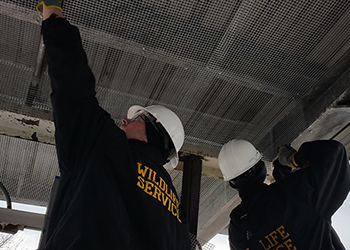
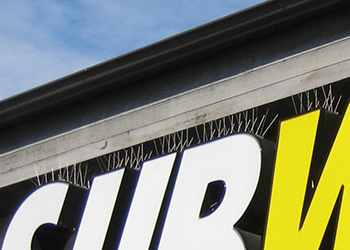
Our company specializes in resolving problems caused by birds in Cincinnati, Ohio, both residential and commerical. We handle bird species such as pigeons, starlings, grackles, sparros, and even Canada Geese and woodpeckers. We generally don't kill birds - we prevent them from causing problems. Most commonly, this means that we install barriers that prevent them access to your building or property, or anti-roosting devices that prevent them from landing, nesting, or roosting on your home, store, building, or anywhere. We use netting, needle strips, shock track, and more. We do offer trapping in some cases, and removal of birds from warehouses, grocery stores, or other commerical or industrial buildings by netting or sometimes pellet shooting. We have a wide variety of tools and methods for solving every manner of bird problem. Call us at 513-342-5191 to discuss your bird problem today.Our Work
Full Range of Bird Control Services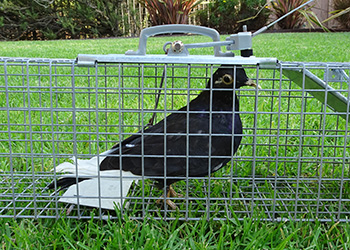
More About Us Cincinnati Bird Control:
When you have bird problems, you should not wait until it's too late. Call us and we will be providing you with a reliable and professional bird removal and exclusion program. We have been servicing different areas and can provide our services to nearby communities. When it comes to bird problems, some people believe that they can handle the problems themselves. However, understand that you are exposing yourself to some dangers like zoonotic diseases and property damages. Moreover, improperly removing, disturbing, or damaging the birds and their nesting area may lead to legal repercussions if you do not carry the necessary permit. Save yourself from all those troubles and allow us to deal with your problems. We have been authorized and certified by the state to address even your problems related to birds that are included in the list of protected species. We have been dealing with all sorts of circumstances related to birds for over ten years now. The locals have recognized us as their prime providers of wildlife exclusion services for three years now. We know how intimidating and overwhelming ‘infestation' can be. We can keep our process simple and effective that will eliminate all your worries against these urban pests.Why Don't I See Pigeon Babies?
Pigeon babies, also known as squabs, are out there. Just because you aren't seeing them doesn't mean they don't exist. It does mean, however, that the parents have done a pretty good job of keeping that nest hidden from sight, thus making the path of survival stronger for their young.
Fact: Pigeons breed all year.
Although peak breeding seasons are in spring and summer, when food is plentiful and the weather is nice, pigeons will actually have multiple ‘litters' of squabs each year. They are usually monogamous birds, meaning that they will have the same breeding partner for life (unless one of them dies), and both males and females can start the reproduction process at quite an early age — only around six to seven months of age.
A female will give birth to one to four eggs, although there are usually only two, and they will hatch around fifteen to twenty days after they have been laid. The squabs are pretty helpless at first, but it doesn't take them long to learn the ropes. In less than a month, the majority of those squabs will have flown the nest, although they do tend to stay there for a bit longer during the colder, winter months, slightly more reliant on their parents for food and protection, as well as warmth. During winter, it is not unusual for a squab to stay with its parents for up to two or three months.
So, where are these pigeon babies?
Most of them are hidden away, in nests. Pigeons build these nests and roosts in spaces that would mimic their natural, wild territory. Cliffs, clifftops, and cliff edges and ledges have been replaced by church steeples, windowsills, TV aerials, the high beams inside factories and warehouses, on the roof, and even in the attic.
How can you find them? Watch where the pigeons are flying in and out of, or the direction that they seem to head at dusk. This is when the flock will return to the roost for the night, and you can use this sunset alarm call (as such) to help you figure out where they are going.
There are other signs; feces is a big giveaway. If you can see trails of feces leading to a particular area of your building, or you notice that feces is littering the walls, you might have just found yourself a nest location. If you can combine that with the direction the birds are travelling at sunset, your theory will be reinforced.
It is very common for females to lay a second round of eggs before her first lot of squabs have flown free to start life as an adult pigeon, which means a pigeon infestation will almost always come with viable eggs or babies in a nest, making life more difficult if you're trying to remove them. If you try to cull any of that flock, just like rodents the pigeons will simply increase the speed at which they breed, not taking very long at all to build those numbers right back up. In some ways, pigeons and rats are very much similar pests, and it is quite common for one of the pests to attract the other. Rats are attracted to the roosting spots because of dead pigeon carcasses and young squabs that didn't make it, and also from the food leftovers that pigeons leave around. They're voracious eaters, but they're not tidy eaters.
We have the most experience in Cincinnati at understanding the nuisance birds of Ohio. Our 7 years of experience in the field ensures excellent results.
We pride ourselves on the quality of our bird control work. Our work is professional grade and long lasting, usually for the life of the building.
We are fully Ohio licensed. We carry the correct safety equipment, and operate in a safe and professional manner to keep your building and people safe.
Call us at 513-342-5191 to discuss your bird problem and our process. We are always responsive by phone. We can usually schedule next-day appointments, and provide written estimates for all our bird work.
Thank you Cincinnati Bird Control for keeping the pigeons off of my storefront. My sidewalks are clean now!
These guys were the only ones who could get a sparrow out of my clothing store. Thank you!
Your goose abatement program has kept my golf course dropping-free. I recommend Cincinnati Bird Control.